
Your crunch routine may be strengthening the wrong muscles — and quietly stressing your spine.
KEY STATISTICS
- Research published in the Journal of Strength and Conditioning Research found that standing core exercises activate up to 30% more oblique muscle fiber than traditional floor crunches.
- The American Chiropractic Association estimates that up to 80% of people will experience back pain at some point — and repetitive spinal flexion exercises are a known contributing factor.
- A 2021 study in the Journal of Human Kinetics found that functional, upright core training improved athletic performance and daily movement efficiency significantly more than mat-based training alone.
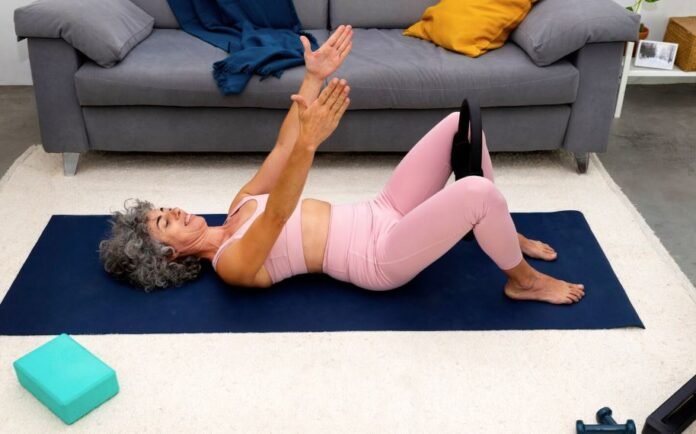
Most people who train their core are doing it in the least useful position possible — flat on their back, staring at the ceiling. Floor crunches isolate one small movement pattern your body rarely uses in real life. Standing dumbbell ab exercises, by contrast, train your core the way it actually functions: upright, loaded, and under real-world pressure.
How Your Core Actually Works
Your core is not just your abs. It includes the obliques, transverse abdominis, erector spinae, multifidus, and the muscles of your hips and pelvis — a full cylinder of tissue that stabilises your spine during every movement you make standing upright.
When you lie on the floor and crunch, you are only working a fraction of that system. You are training spinal flexion in a protected position where gravity is mostly removed and your body has no need to stabilise itself laterally, rotationally, or against external load.
Standing dumbbell exercises force your core to work anti-rotationally and anti-laterally. These are the movements your body actually performs when you carry shopping, reach overhead, twist to reverse a car, or absorb unexpected movement. The muscles recruited are deeper, more numerous, and more functionally relevant.
Repeated spinal flexion under load — which is essentially what crunches are — has been criticised by spine researchers including Dr. Stuart McGill at the University of Waterloo. His work suggests that cumulative disc compression from repeated flexion may contribute to long-term spinal wear, particularly when posture is already compromised by hours of sitting.
Why Your 20s Matter
Adults between 25 and 35 are in a critical window. Core strength established now forms the structural foundation for how your spine performs in your forties, fifties, and beyond.
This is also the decade when most people spend eight or more hours a day seated. Sitting shortens the hip flexors and weakens the posterior chain. When you then crunch repeatedly, you are reinforcing the very flexion pattern that sitting already overloads.
Standing dumbbell core training counteracts this. It reintroduces anti-gravity load, activates the glutes and lateral hip stabilisers, and trains your body in the positions it needs most to remain pain-free and functional over the long term.
Warning Signs to Watch For
- You feel lower back discomfort or tightness during or after your ab workout — this can indicate spinal flexion overload rather than genuine core strengthening.
- Your core feels strong in the gym but you still feel unstable, achy, or fatigued during daily tasks like carrying bags or standing for long periods.
- You have a visible anterior pelvic tilt — where your lower back arches forward and your belly tilts down — which suggests hip flexor dominance and weak deep stabilisers.
- You experience neck strain during crunches, meaning you are compensating with your neck and hip flexors rather than recruiting your abdominal muscles effectively.
- You have been training your core consistently for months but notice no improvement in posture, balance, or back comfort — a sign your training stimulus is not matching your functional needs.
What Actually Helps
The foundation of standing ab training is learning to brace, not just flex. Bracing means creating 360 degrees of tension around your midsection before any movement begins — like you are about to take a punch. This is how your core actually protects your spine.
Dumbbell suitcase carries are one of the most underrated core exercises available. You hold a dumbbell in one hand and walk with a tall, neutral spine. Your obliques and quadratus lumborum must work hard to prevent you from tilting to the loaded side.
It builds real lateral stability in minutes.
Dumbbell woodchops train rotational power through a diagonal plane. This mirrors how your body moves when throwing, swinging, or twisting — movements that crunches never prepare you for. Start light, focus on hip rotation as the driver, and keep the movement controlled.
Dumbbell overhead carries and single-arm presses challenge the core through the shoulders. When one side is loaded overhead, your entire trunk must resist lateral flexion and rotation simultaneously. This is full-system core engagement that no floor exercise can replicate at the same intensity.
Action Plan Checklist
- Replace crunches with three standing core exercises: dumbbell suitcase carry, dumbbell woodchop, and single-arm overhead press — perform 3 sets of each, 2 to 3 times per week.
- Learn the abdominal brace before adding weight: stand tall, exhale fully, then draw your midsection in and outward simultaneously as if bracing for impact — hold for five seconds and repeat five times before each session.
- Start with a light dumbbell (4 to 8 kg) and prioritise perfect spinal alignment over load — your lower back should maintain its natural curve throughout every movement.
- Incorporate a 10-minute standing core circuit at the end of your lower body or cardio sessions when your body is already warm and neurologically primed.
- Assess your posture monthly — photograph yourself from the side in a neutral standing position and look for changes in pelvic tilt, shoulder position, and head alignment as markers of genuine core progress.
The Breathing Factor
Breathing is the overlooked variable that determines whether your standing core work is actually working. Most people hold their breath or breathe shallowly during exercises, which reduces intra-abdominal pressure and diminishes core activation significantly.
Practice what sports physiotherapists call pressure breathing: inhale through your nose before the effort phase, then exhale slowly and forcefully through slightly pursed lips during the hardest part of the movement. This creates an internal pressure system that protects your spine and amplifies core muscle recruitment.
Once you connect breath to movement, every standing dumbbell exercise becomes measurably more effective. It also trains a breathing pattern that carries over into daily life — meaning your core supports your spine automatically, not just when you are consciously thinking about it.
Bottom Line
Crunches are not harmful for everyone, but they are incomplete for anyone who wants a strong, resilient, pain-resistant core that functions in the real world. Standing dumbbell exercises train your core in upright, loaded, multi-planar positions that match how your body actually moves every single day. Swap the mat for standing work, learn to brace and breathe, and your core — and your back — will respond in ways crunches never delivered.
Always consult a qualified healthcare provider before making changes to your health routine.
Sources
- Comparison of muscle activation during standing and supine core exercises — Journal of Strength and Conditioning Research
- Functional core training and athletic performance outcomes — Journal of Human Kinetics
- Spine biomechanics and the risks of repeated spinal flexion under load — Clinical Biomechanics
- Back pain prevalence and contributing mechanical factors — American Chiropractic Association
- Intra-abdominal pressure and core stability during resistance exercise — Journal of Applied Physiology

