
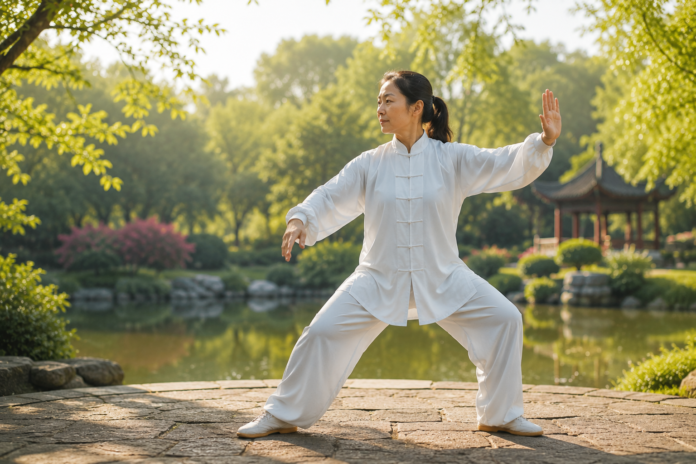
*Can a gentle Chinese practice actually reshape your sleep and mood?*
KEY STATISTICS
- Myth: Baduanjin is just stretching and won’t change sleep or mood.
- Fact: Randomized trials show measurable improvements in sleep quality and depressive symptoms in older adults.
- Reality check: Results are modest but consistent—this isn’t a miracle cure, it’s a tool that works for many.
You’ve probably heard that exercise fixes everything—but what if the exercise you’re picturing is all wrong? While most people chase high-intensity workouts, a growing body of research suggests that a slow, flowing 2,000-year-old Chinese practice called Baduanjin might be quietly doing something your gym routine isn’t: improving sleep depth, lifting depressive symptoms, and reshaping body composition in ways that matter. The catch?
It’s so gentle that many dismiss it as ineffective. Here’s what the evidence actually shows.
How Baduanjin Changes Your Body
Baduanjin, literally ‘Eight Pieces of Brocade,’ is a sequence of slow, controlled movements combined with focused breathing and mental attention. Unlike high-impact cardio, Baduanjin appears to work through a gentler pathway—calming your nervous system, regulating hormone release, and improving how your body coordinates movement and awareness.
- Activates parasympathetic nervous system (rest-and-recover mode), which downregulates stress hormones like cortisol.
- Improves proprioception and motor control through deliberate, mindful movement—building mind-body connection often lost in aging.
- Enhances circulation and oxygen delivery without the cardiovascular spike of vigorous exercise.
- Reduces systemic inflammation markers, which are linked to both poor sleep and mood disorders.
Why This Matters for Your Future
If you’re in your late 20s to mid-30s, sleep disruption and low mood might still feel occasional. But research on older adults—the population most heavily studied for Baduanjin—reveals that once sleep architecture begins to fragment and mood dips, the cascade often worsens. Your age group is the perfect time to prevent that slide.
- Poor sleep in your 20s and 30s sets the stage for chronic sleep issues in your 40s and beyond.
- Early-onset depressive symptoms or mood fluctuations often worsen without intervention; gentle, consistent movement is preventive.
- Body composition changes accelerate with age—maintaining muscle and managing weight becomes harder if you don’t establish habits now.
- Stress and sedentary work compound over time; low-impact practices like Baduanjin prevent injury while building resilience.
Signs You Might Benefit
- Waking after 5-6 hours and unable to fall back asleep, or waking unrefreshed despite full night
- Persistent low mood, lack of motivation, or loss of interest in activities you normally enjoy
- Chronic neck, shoulder, or lower back tension that doesn’t improve with stretching alone
- Feeling ‘wired but tired’—mentally alert but physically exhausted, or vice versa
- Noticeable weight gain or loss of muscle tone despite stable diet and activity
- Frequent irritability or difficulty concentrating that seems disconnected from life events
What Evidence Shows Works
The evidence for Baduanjin comes largely from randomized controlled trials in older populations, but the mechanisms apply across ages. Regular, gentle practice appears to work best when combined with consistent timing, mindful attention, and modest dietary awareness—not because Baduanjin is magic, but because these practices together create conditions for change.
- Practice Baduanjin or similar gentle movement (tai chi, qigong) 3–4 times weekly for 20–30 minutes to see measurable sleep improvement.
- Pair movement practice with consistent sleep timing—going to bed and waking at the same time, even on weekends.
- Combine with modest dietary shifts: reduce caffeine after 2 p.m., prioritize protein and fiber, and eat dinner 2–3 hours before bed.
- Add mindfulness or breathing focus during practice; the mental component matters as much as the physical movement.
Your Starting Checklist
- Find a certified Baduanjin, tai chi, or qigong instructor online or in your area; many community centers and YMCAs offer beginner classes.
- Start with 2 sessions per week for 3 weeks, then increase to 3–4 if it fits your schedule and feels sustainable.
- Track sleep using a simple journal (bedtime, wake time, how rested you feel) for 2 weeks before and 6 weeks after starting.
- Set a fixed practice time—early morning or early evening works best for most people to avoid sleep disruption.
- Commit to 8 weeks minimum before deciding if it’s working for you; changes in sleep quality and mood take time to register.
The Consistency Factor
One overlooked factor in the Baduanjin research is consistency. The studies showing real improvements typically involved participants who practiced regularly for 8–12 weeks, not those who tried it once or twice. This quiet, steady approach to health—the opposite of a quick fix—may be why it works when flashier interventions don’t.
- Gentle, regular practice builds neuroplasticity and nervous system rebalancing—neither happens overnight.
- Baduanjin fits easily into a busy life because it’s low-injury risk and requires no equipment or gym membership.
- The meditative component addresses the mind-body disconnect common in desk-bound 25- to 35-year-olds, improving sleep onset naturally.
Bottom Line
Baduanjin isn’t a cure-all, and if you’re struggling with severe insomnia or depression, you’ll need professional support. But for the growing number of younger adults wrestling with fragmented sleep, creeping mood issues, and the physical toll of sedentary work, this slow, focused practice offers a legitimate, evidence-backed tool. The fact that it’s gentle and ancient doesn’t make it less effective—it just means the change is subtle enough that you might miss it if you’re not paying attention.
365 Live Long — always consult a qualified healthcare provider before making changes to your health routine.
Sources
- Effects of Baduanjin exercise on sleep quality, depressive symptoms, quality of life, and body composition in older adults: a systematic review and meta-analysis of randomized controlled trials — Frontiers in Public Health
- Sleep and Mental Health — National Institutes of Health
- Physical Activity Guidelines for Adults — CDC

