
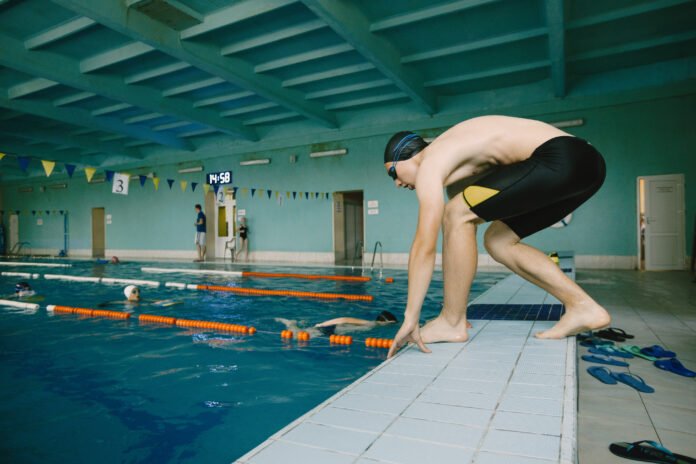
Your weekly run is quietly compressing joints and creating imbalances — one swim session a week can undo the damage.
KEY STATISTICS
- Runners experience injury rates of up to 79% per year, with knees, hips, and shins bearing the highest load — American Journal of Sports Medicine.
- Swimming activates up to 90% of major muscle groups simultaneously, including those chronically underused by runners — NIH National Library of Medicine.
- Just one aquatic exercise session per week has been shown to reduce joint pain and improve functional mobility in active adults — Mayo Clinic.
If you run regularly, you are doing something genuinely great for your cardiovascular health. But running is a high-impact, single-plane movement — and over time, it quietly creates muscular imbalances, compresses your cartilage, and leaves entire muscle groups undertrained. One swim session a week can counteract almost all of it.
What Running Does To You
Every time your foot hits the ground while running, your joints absorb roughly two to three times your body weight in impact force. Over the course of a standard 5K, that force is transmitted through your ankles, knees, hips, and lower spine thousands of times.
Running also predominantly strengthens the posterior chain — your calves, hamstrings, and glutes — while underloading your hip flexors, rotator cuff muscles, upper back, and chest. This creates a predictable pattern of imbalance that shows up as poor posture, nagging injuries, and reduced range of motion over time.
Swimming changes the equation entirely. Water reduces effective body weight by up to 90%, removing compressive load from joints while simultaneously requiring your body to stabilise, pull, rotate, and extend in multiple planes of movement. The result is decompression for overloaded joints and activation for the muscles running consistently ignores.
Why Your Twenties Matter
Adults between 25 and 35 are often in what feels like peak physical condition — and that confidence can be a liability. This is the decade when cumulative damage starts accumulating faster than the body can repair it silently.
Cartilage has no blood supply of its own. It relies on movement and synovial fluid for nutrients. Repetitive high-impact loading without adequate recovery or cross-training gradually reduces cartilage resilience, often with no pain signal until the damage is already established.
Muscular imbalances developed in your late twenties tend to calcify into chronic patterns by your mid-thirties. A runner who never cross-trains is likely building the foundation for a hip, knee, or lower back problem that will not announce itself until their forties.
Warning Signs To Watch For
- Persistent tightness or aching in one or both knees after runs, even short ones
- Lower back stiffness that takes more than 30 minutes to ease in the morning
- One hip sitting higher than the other when you stand or walk
- Recurring shin splints or Achilles discomfort that never fully resolves between runs
- Shoulder rounding and upper back tightness that worsens after long training weeks
What Actually Helps
You do not need to become a competitive swimmer. The goal is one session per week — approximately 30 to 45 minutes — using basic strokes that complement your running mechanics.
Freestyle swimming directly counteracts the forward-hunched posture running can reinforce by opening the chest, activating the upper back, and building shoulder strength. Breaststroke strengthens the hip adductors and inner thighs — muscles almost entirely passive during a run. Backstroke works the posterior shoulder and thoracic extensors, undoing the forward pull of repetitive arm-drive running form.
You do not need to swim at speed or cover huge distances. Controlled, deliberate laps with attention to full extension and breathing rhythm deliver the muscular and joint benefits. Think of it as physiotherapy that also keeps your heart rate elevated.
Action Plan Checklist
- Schedule one 30–45 minute swim session per week on a rest or easy day, not immediately after a hard run
- Alternate between freestyle, breaststroke, and backstroke each session to cover all the muscle groups running underloads
- Focus on full arm extension with each stroke — this is where the postural correction and shoulder activation happens
- Use a kickboard for 5–10 minutes per session to isolate hip flexors and inner thighs without upper body fatigue
- End each swim with two to three minutes of slow backstroke to decompress the spine and reset posture before leaving the pool
The Breathing Benefit Nobody Mentions
The overlooked factor here is breathing mechanics. Running tends to train shallow, rhythmic chest breathing under load. Swimming forces you to develop diaphragmatic breath control — you have no choice but to breathe deliberately and efficiently.
Stronger diaphragmatic breathing carries over directly into running performance. Runners who swim regularly often report reduced side stitches, better pace control, and a lower perceived effort at the same speed. It is a cross-training benefit that almost nobody talks about.
Beyond performance, controlled breathing during swimming activates the parasympathetic nervous system — the rest-and-digest state. For runners who train hard and carry high stress loads, this alone makes a weekly swim session worth building into the schedule.
Bottom Line
Running is not the enemy — but doing only running is. Adding one swim session per week gives your joints the decompression they need, activates the muscles your run ignores, and builds the breathing mechanics that make you a better athlete overall. It is one of the simplest cross-training upgrades available, and it requires no special equipment beyond a pool and thirty minutes of your week.
Always consult a qualified healthcare provider before making changes to your health routine.
Sources
- Epidemiology of running injuries in recreational and competitive runners — American Journal of Sports Medicine
- Aquatic exercise for the rehabilitation of daily functional activities in adults — NIH National Library of Medicine
- Water exercise and joint health in active adults — Mayo Clinic
- Musculoskeletal injuries in distance runners: prevalence and risk factors — British Journal of Sports Medicine
- Diaphragmatic breathing and its effects on athletic performance and recovery — Journal of Physical Therapy Science

