
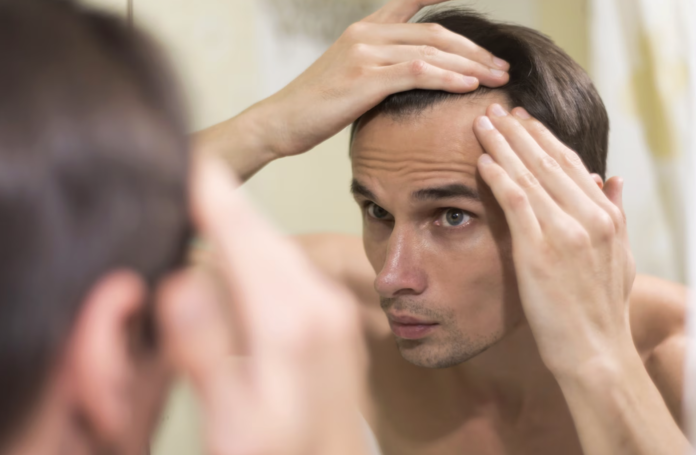
The health of your scalp in your late twenties is quietly setting the stage for how much hair you keep in your thirties and beyond.
KEY STATISTICS
- Approximately 40% of women and 50% of men show noticeable hair thinning by age 35, according to the American Academy of Dermatology.
- Research published in the Journal of Investigative Dermatology found that scalp microbiome imbalances were present in over 60% of early-onset hair thinning cases studied.
- Sebum overproduction on the scalp can raise local DHT levels — the hormone most directly linked to follicle miniaturisation and eventual hair loss.
Most people assume hair loss is something that happens to other people, or at least to a future version of themselves. But the biological conditions that lead to thinning hair often develop silently in your late twenties — long before you notice extra strands in the shower drain. The good news is that the scalp is a living ecosystem, and ecosystems can be restored.
What Your Scalp Is Doing
Your scalp is not just skin with hair growing out of it. It is a complex microbiome environment — home to billions of bacteria, fungi, and sebaceous glands that regulate the conditions around every follicle.
When this ecosystem is balanced, follicles receive the right pH, the right oxygen flow, and the right microbial support to cycle through healthy growth phases. When it tips out of balance, inflammation sets in at the follicle level — and chronic inflammation is one of the most well-documented drivers of premature hair miniaturisation.
Sebum, the natural oil your scalp produces, plays a central role here. At the right levels, it protects the scalp barrier and keeps follicles lubricated. But overproduction — triggered by stress, diet, hormonal shifts, or over-washing — creates an environment where a yeast called Malassezia thrives and inflammatory byproducts build up around the follicle base.
This is where the connection to DHT becomes important. Dihydrotestosterone is a hormone converted from testosterone that binds to receptors in genetically sensitive follicles, causing them to shrink over time. An inflamed, sebum-heavy scalp amplifies this process — making the follicle environment far more hostile than it would otherwise be.
Why Your Twenties Matter
Your late twenties are a turning point for scalp health that most people completely ignore. Sebaceous gland activity tends to peak in your mid-to-late twenties, meaning sebum overproduction is most likely to cause problems right now.
At the same time, the stress loads typical of this age group — career pressure, sleep disruption, dietary shortcuts — elevate cortisol, which directly stimulates sebum production and suppresses the anti-inflammatory signals that protect follicles.
Your hair follicles also operate on a long cycle. The damage happening at the scalp level today may not show up visually as thinning for another two to five years. That delay is exactly why acting in your late twenties matters so much — you are working with a window that closes gradually and quietly.
Warning Signs to Watch For
- Increased hair shedding during washing or brushing, beyond the normal 50 to 100 strands per day
- Persistent scalp itchiness, flakiness, or greasiness that returns within 24 hours of washing
- A widening parting line or reduced density at the temples or crown
- Scalp that feels tender or tight, particularly after periods of high stress
- Visible redness or small bumps at the hairline or along the part — signs of follicular inflammation
What Actually Helps
The most effective starting point is reducing scalp inflammation, and that begins with what you eat. Diets high in refined sugar and processed seed oils have been shown to increase systemic inflammation, which reaches the scalp the same way it reaches joints and arteries.
Omega-3 fatty acids — found in oily fish, flaxseed, and walnuts — have direct anti-inflammatory effects that extend to scalp tissue. Studies in the Journal of Cosmetic Dermatology have linked omega-3 supplementation with reduced hair shedding and improved follicle density in women with thinning hair.
Zinc and biotin are two micronutrients frequently deficient in adults aged 25 to 35, particularly those eating calorie-restricted or heavily processed diets. Both are essential for the keratin production that forms each hair strand, and deficiency in either can accelerate shedding.
On the topical side, ingredients such as ketoconazole shampoo (used twice weekly) have been shown in clinical trials to reduce Malassezia-driven inflammation and rival some pharmaceutical hair loss treatments in follicle preservation. Caffeine-based topicals have also shown promising results in early research by extending the follicle growth phase. These are not magic fixes — but used consistently, they shift the scalp environment in the right direction.
Action Plan Checklist
- Switch to a scalp-focused shampoo containing ketoconazole or zinc pyrithione at least twice per week to control Malassezia overgrowth
- Add omega-3 fatty acids to your diet through two to three servings of oily fish weekly, or a high-quality fish oil supplement
- Get your ferritin, zinc, vitamin D, and biotin levels checked — all four are commonly low in this age group and all four affect hair growth
- Reduce washing to once daily maximum and follow with a lightweight, non-comedogenic scalp conditioner to avoid sebum overproduction rebound
- Introduce a two-minute scalp massage daily using fingertips — research from ePlasty journal found consistent scalp massage increased hair thickness over 24 weeks by stimulating follicle circulation
The Sleep Factor Nobody Mentions
One factor almost never discussed in mainstream hair loss conversations is the role of chronic low-grade sleep disruption on follicle health. During deep sleep, growth hormone is released — and this is the same growth hormone that drives the anagen (active growth) phase of your hair cycle.
Adults aged 25 to 35 are statistically the most sleep-deprived demographic, often functioning on six hours or fewer due to work, social schedules, or screen time habits. Over months and years, this suppresses growth hormone pulses and pushes more follicles into the telogen (resting and shedding) phase simultaneously.
This is why some people notice dramatic increases in shedding during periods of sustained stress or poor sleep — it is not just a coincidence. Prioritising seven to nine hours of consistent sleep is not just a recovery tool; for your scalp, it is an active biological treatment that no topical product can fully replace.
Bottom Line
Your scalp is an organ with its own microbiome, its own hormonal environment, and its own inflammatory risks — and what you do with it in your late twenties shapes what you see in your mid-thirties. Thinning hair is rarely sudden; it is the visible result of a slow process that was already underway. The scalp health habits you build now are the most practical form of long-term hair loss prevention available to you.
Always consult a qualified healthcare provider before making changes to your health routine.
Sources
- Sebaceous gland activity and its relationship to androgenetic alopecia — Journal of Investigative Dermatology
- Scalp microbiome and dandruff: a comprehensive review — Experimental Dermatology
- Effect of omega-3 and omega-6 fatty acids on hair loss in women — Journal of Cosmetic Dermatology
- Standardised scalp massage results in increased hair thickness — ePlasty — Open Access Journal of Plastic Surgery
- Androgenetic alopecia: pathogenesis and potential for therapy — Expert Reviews in Molecular Medicine, Cambridge University Press

