
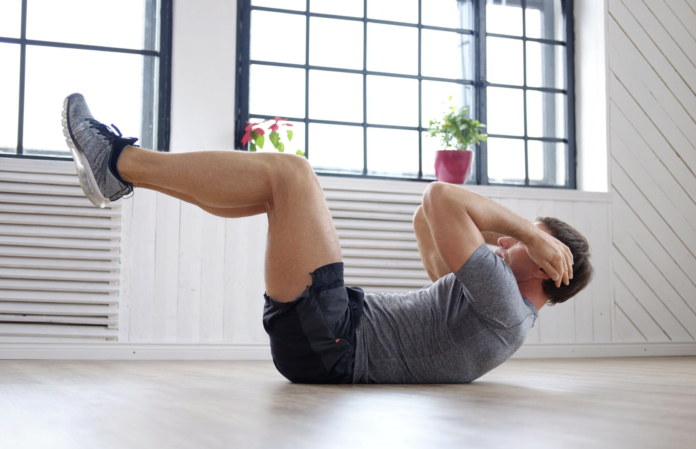
Standing dumbbell exercises activate deeper core muscles that floor crunches completely miss — and your body needs them now.
KEY STATISTICS
- Research published in the Journal of Strength and Conditioning Research found that standing core exercises activate the transverse abdominis up to 30% more than traditional floor-based crunches.
- The American Council on Exercise reports that fewer than 20% of gym-goers train their deep stabilizing muscles — the ones responsible for injury prevention and functional strength.
- A 2022 study from the National Institutes of Health found that adults who perform functional, upright resistance training report significantly fewer lower back pain episodes compared to those who rely solely on mat-based ab work.
Most people spend years doing crunches and still wonder why their lower back aches, their posture slumps, and their core feels weak the moment they lift something heavy. The problem is not effort — it is the wrong exercise. Standing dumbbell core work targets the muscles your body actually uses every day, and the difference is not subtle.
What Your Core Actually Does
Your core is not just your six-pack. It is a deep, layered system of muscles that includes the transverse abdominis, multifidus, obliques, and pelvic floor — all working together to stabilize your spine before your limbs even move.
When you lie on the floor and crunch, you primarily recruit the rectus abdominis, the outermost layer of abdominal muscle. That muscle looks good in a mirror, but it does very little to protect your lower back during real-world movements like carrying bags, twisting, or lifting.
Standing exercises force your nervous system to coordinate balance, posture, and core tension simultaneously. A standing dumbbell woodchop or a loaded carry activates the deep stabilizers because your body needs them to stay upright — something no floor exercise can replicate.
Why Your 20s Matter
Between 25 and 35, most adults are in their most physically active decades — but also the years when sedentary desk habits, long commutes, and reduced structured movement quietly erode core stability.
By your late twenties, the deep spinal muscles can begin showing early signs of deconditioning if you are sitting for more than six hours a day. This is not visible on the outside, but it shows up as fatigue, lower back stiffness, and poor movement patterns.
Building functional core strength now is one of the most effective ways to prevent the back pain, disc issues, and postural problems that become dramatically harder to fix after 40.
Warning Signs to Watch For
- You feel lower back tightness or ache after sitting for a few hours, even without any injury history
- Your posture collapses forward during long work sessions and you find it difficult to hold yourself upright without thinking about it
- You feel unstable or shaky during squats, lunges, or any single-leg movement — even at low weights
- Carrying groceries, a backpack, or a child in one arm causes noticeable strain or imbalance in your torso
- You have been doing crunches or sit-ups regularly but still feel weak or unsupported through the midsection during daily activities
What Actually Helps
Standing dumbbell core exercises work because they replicate the demands of real life. Movements like the dumbbell suitcase carry, standing woodchop, overhead press, and single-arm farmer’s walk all require your core to brace, stabilize, and transfer force — exactly what happens when you move through the world.
Start with light to moderate weights. The goal is not to load the movement heavily — it is to challenge your balance and stability so your deep muscles have to work. A 10 to 15-kilogram dumbbell in a single-arm carry will do more for your core than a full set of weighted crunches.
Consistency matters more than intensity here. Adding two to three sets of standing core work three times per week can produce noticeable improvements in stability, posture, and lower back comfort within six to eight weeks.
Action Plan Checklist
- Replace half your floor ab exercises with standing alternatives — start with dumbbell suitcase carries and standing woodchops performed in a controlled, slow tempo
- Add a single-arm overhead press to your routine and focus on keeping your torso completely still as the weight moves — this alone will expose and strengthen core weakness
- Practice the farmer’s walk for 30 to 40 metres with a dumbbell in one hand only, switching sides — this trains anti-lateral flexion, one of the most undertrained core functions
- Incorporate a standing pallof press using a resistance band or cable to build anti-rotation strength, which protects your spine during twisting movements
- Before each workout, spend 60 seconds bracing your core while standing — breathe in, expand your ribcage 360 degrees, then gently tighten your midsection without sucking it in; this retrains your breathing and deep stability patterns
The Breathing Factor You’re Ignoring
Breathing is the most overlooked part of standing core training — and most people get it completely wrong. Many gym-goers hold their breath or brace by sucking their stomach in, which actually reduces deep core activation and increases spinal compression.
Learning intra-abdominal pressure — the technique used by physiotherapists and strength coaches — means breathing into your belly and sides before bracing, creating a 360-degree pressure belt around your spine. This is what protects you during a heavy lift or an awkward movement.
Spend five minutes a day practising diaphragmatic breathing in a standing position. It sounds simple, but it is the foundation that makes every other core exercise more effective and safer.
Bottom Line
Floor crunches are not useless, but they are incomplete. Your core was built to stabilize your body against gravity, rotation, and load — and only standing exercises train it that way. Add dumbbell-based upright core work to your routine now, before poor stability turns into back pain you cannot ignore.
Always consult a qualified healthcare provider before making changes to your health routine.
Sources
- Electromyographic Analysis of Core Muscle Activation During Standing vs. Supine Exercises — Journal of Strength and Conditioning Research
- Core Stability and Its Relationship to Lower Back Pain — American Journal of Physical Medicine and Rehabilitation
- Functional Movement and Deep Stabilizer Activation in Resistance Training — National Institutes of Health — National Library of Medicine
- The Role of the Transverse Abdominis in Spinal Stabilization — Journal of Orthopaedic and Sports Physical Therapy
- Exercise Recommendations for Core Conditioning and Injury Prevention — Mayo Clinic — Healthy Lifestyle, Fitness

