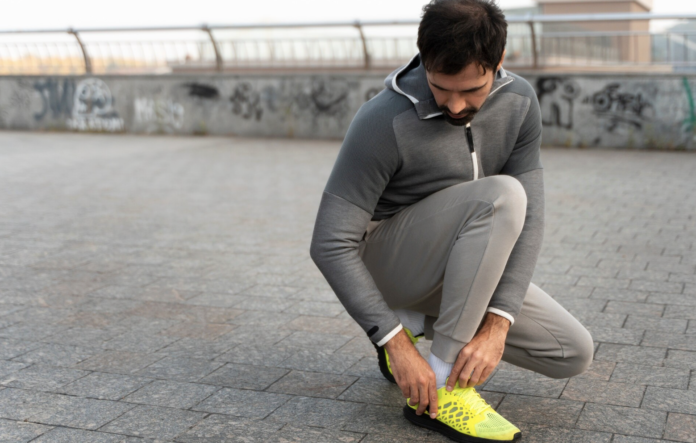
Modern footwear quietly switches off the muscles your feet were built to use — and your knees, hips, and back are paying the price.
KEY STATISTICS
- Research published in Scientific Reports found that people who regularly walk barefoot have significantly stronger intrinsic foot muscles than those who wear conventional footwear daily.
- A study in the Journal of Foot and Ankle Research found that up to 87% of adults experience foot pain at some point in their lives, with poor foot muscle strength cited as a key contributing factor.
- The American Podiatric Medical Association estimates that the average American takes between 8,000 and 10,000 steps per day — nearly all of them inside shoes that limit natural foot movement.
You have walked tens of thousands of steps this year, but the muscles inside your feet may barely have done any real work. Modern shoes — cushioned, structured, and supportive — do the job your foot muscles are supposed to do, and over time, those muscles quietly switch off. The result is a foundation that looks fine on the outside but is quietly failing from the ground up.
What Shoes Are Doing
Your foot contains 26 bones, 33 joints, and over 100 muscles, tendons, and ligaments. This architecture is designed to sense the ground, absorb shock, generate propulsion, and stabilise your entire body above it.
When you wear heavily cushioned or rigid footwear, the foot no longer needs to actively respond to the surface below. The intrinsic muscles — the small but critical muscles that live entirely within the foot — stop being recruited regularly.
Over time, those muscles weaken through a process called disuse atrophy. Research from Harvard’s Department of Human Evolutionary Biology has shown that habitually shod populations display measurably smaller and weaker foot muscles compared to those who spend significant time barefoot.
This matters far beyond your feet. Weak foot muscles alter your gait mechanics, shifting stress upward through your ankles, knees, hips, and lower back. Podiatrists and physiotherapists refer to this as the kinetic chain — a connected sequence where weakness at the base creates compensations higher up.
Why Your 20s Matter
Adults between 25 and 35 are at a particularly underestimated risk because this is the decade when movement habits solidify and compensations begin compounding.
Many people in this age group are desk-bound during the day and then suddenly active in the evenings or on weekends — running, lifting, playing sport — without the foot strength to support those demands. That mismatch is a common driver of plantar fasciitis, shin splints, IT band syndrome, and knee pain.
This is also the age when most people start noticing those injuries for the first time and assume they are just getting older. In many cases, the root cause is not age — it is a foot that has been passively carried inside a shoe for years without ever being asked to do its job.
Warning Signs To Watch
- Recurring plantar fasciitis or heel pain that does not fully resolve between flare-ups
- Unexplained knee pain during running or squatting with no clear structural diagnosis
- Ankle instability or a tendency to roll your ankle on uneven surfaces
- Lower back tightness that worsens after long periods of walking or standing
- Toes that have curled inward or spread unevenly — a sign that footwear has been reshaping your foot structure over time
What Actually Helps
The most effective way to begin reactivating dormant foot muscles is gradual barefoot exposure on varied surfaces. Grass, sand, gravel paths, and wooden floors all challenge the foot differently, forcing it to sense and respond rather than passively absorb.
Start with five to ten minutes of barefoot walking per day on a safe, natural surface. Your feet will feel more fatigued than you expect — that fatigue is the intrinsic muscles waking up after years of minimal use.
Minimalist footwear is a useful middle ground for those who cannot go fully barefoot outdoors. Shoes with a wide toe box, thin sole, and zero drop — meaning no raised heel — allow the foot to move more naturally while still providing basic protection.
Targeted foot exercises also accelerate the process. Toe spreads, single-leg balance holds, short foot exercises — where you contract the arch without curling the toes — and calf raises performed on an uneven surface all directly strengthen the muscles that conventional shoes suppress.
Consistency matters more than intensity here. Daily low-dose barefoot time and foot-specific movement will build more functional strength over three months than occasional long barefoot walks.
Action Plan Checklist
- Start with 5–10 minutes of barefoot walking daily on grass or a natural surface and build gradually over several weeks
- Practice the short foot exercise: while seated, try to shorten the distance between your heel and the ball of your foot by contracting your arch — hold for 5 seconds, repeat 10 times each foot
- Spend time at home barefoot rather than in slippers — indoor barefoot time adds up quickly and costs nothing
- If buying new shoes, look for a wide toe box, thin flexible sole, and minimal heel elevation — these features allow more natural foot function
- Add single-leg balance holds to your daily routine — aim for 30 seconds per leg on a slightly uneven surface to activate foot stabilisers
The Proprioception Problem
One often-overlooked factor is the role of proprioception — your foot’s ability to sense its own position in space and communicate that information to your brain and nervous system.
The sole of the foot is packed with sensory receptors. When thick cushioning insulates the foot from the ground, those receptors receive less information, and your body’s ability to balance, react, and move efficiently is quietly reduced.
This has implications well beyond injury prevention. Research in the Journal of Neurophysiology has linked poor lower limb proprioception to increased fall risk, even in younger adults who consider themselves physically active. Barefoot walking directly restores this sensory feedback loop by allowing your foot to feel what it is standing on.
The good news is that proprioception responds quickly to training. Even a few weeks of regular barefoot exposure has been shown to improve balance and lower-limb coordination in active adults.
Bottom Line
Your feet are not passive passengers — they are the foundation of every movement you make. Years of cushioned footwear can silently weaken that foundation, creating a chain of compensations that shows up as knee pain, hip tightness, or recurring injuries. Reintroducing barefoot time gradually, consistently, and thoughtfully is one of the lowest-cost, highest-return investments you can make in your long-term physical health.
Always consult a qualified healthcare provider before making changes to your health routine.
Sources
- Foot muscle size and walking in habitually barefoot versus shod populations — Scientific Reports — Nature Publishing Group
- Prevalence of foot pain and its association with general health status in community-dwelling older adults — Journal of Foot and Ankle Research
- Intrinsic foot muscle volume in minimally shod and conventionally shod adults — Journal of Science and Medicine in Sport
- Proprioception and neuromuscular control of the lower extremity — Journal of Athletic Training — National Athletic Trainers Association
- Foot and ankle conditioning for active adults — Harvard Health Publishing — Harvard Medical School