
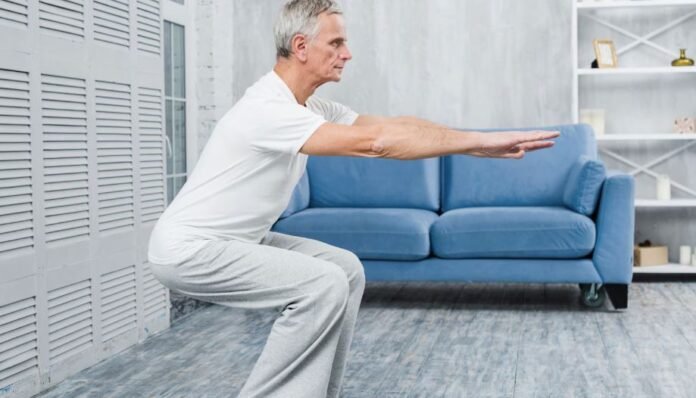
If your knees cave and your lower back aches during squats, your ankles are probably the hidden culprit — and two daily drills can change everything.
KEY STATISTICS
- Up to 70% of people with knee pain during squats show measurable ankle dorsiflexion restrictions, according to research published in the Journal of Orthopaedic and Sports Physical Therapy.
- The American Academy of Orthopaedic Surgeons reports that poor lower limb mobility is one of the leading contributors to compensatory movement patterns that accelerate joint wear in adults under 40.
- Studies in the Journal of Strength and Conditioning Research found that just four weeks of targeted ankle mobility work improved squat depth and reduced knee valgus collapse in recreational athletes.
You have been squatting for months, maybe years, and your knees still ache, your heels still want to lift, and your lower back takes a hit on every rep. The problem almost certainly is not your knees or your back. It starts five joints lower — at your ankles.
What Happens In Your Body
Dorsiflexion is the movement that brings your toes toward your shin. When you squat, your ankle needs to dorsiflex significantly to allow your knee to travel forward over your foot while your heel stays flat on the ground.
When that range of motion is restricted, your body does not simply stop. It compensates. Your heel lifts, your trunk pitches forward, your knees collapse inward, and your lumbar spine rounds under load.
This is called a compensatory movement pattern, and it shifts mechanical stress away from the muscles designed to handle it — mainly your glutes and quads — and dumps it onto your knee joints and lower back instead.
Over time, that redistributed load does not just cause discomfort during training. It quietly degrades cartilage, strains the patellar tendon, and compresses the lumbar discs in ways that build into real, lasting problems.
Why Your Age Matters
Adults between 25 and 35 are in a uniquely vulnerable window. You are old enough to have accumulated years of desk sitting, which progressively shortens the calf complex and stiffens the ankle joint. But you are also young enough to still be training hard and loading those restrictions with weight.
Sitting with your ankle in a plantar-flexed position — foot pointed down, as it is under a desk — for eight or more hours a day tightens the gastrocnemius and soleus muscles. These two muscles attach above and below the knee and directly restrict how far your ankle can dorsiflex.
Most people in this age group notice the symptoms first in their knees or lower back and never trace the cause back to the ankle. That misdirection is exactly why the restriction keeps getting worse while the injuries keep accumulating.
Warning Signs To Watch For
- Your heels lift off the ground before you reach parallel depth in a squat
- Your knees cave inward rather than tracking over your second toe during the descent
- You feel lower back tightness or compression at the bottom of a squat or lunge
- You cannot keep your torso upright without leaning heavily forward during any squat variation
- You notice that placing a small heel raise under your feet immediately makes squats feel easier and more comfortable
What Actually Helps
The good news is that ankle dorsiflexion responds quickly to targeted mobility work — faster than most joint restrictions. Two drills, done daily, address both the muscular and joint capsule components of the restriction.
The first is the banded ankle mobilisation. Loop a resistance band around a squat rack or fixed point at ankle height, place it around the front of your ankle, and step forward to create tension pulling the ankle forward. From there, drive your knee forward over your little toe repeatedly for 10 to 15 reps on each side.
This targets the joint capsule itself, not just the muscles.
The second drill is the wall ankle stretch. Stand facing a wall, place your foot about 10 cm from the base, and drive your knee toward the wall while keeping your heel flat. Hold for 30 to 45 seconds, then repeat on the other side.
This lengthens the gastrocnemius and soleus under a sustained stretch.
Doing both drills before every lower body session — and ideally once on off days too — is enough to produce noticeable improvement within two to three weeks for most people.
Action Plan Checklist
- Test your dorsiflexion now: stand 12 cm from a wall and try to touch your knee to the wall without your heel lifting — if you cannot, restriction is present
- Do 2 sets of 15 banded ankle mobilisations on each side before every squat or lunge session
- Follow with a 45-second wall ankle stretch on each side, keeping the heel firmly planted throughout
- During training, use a small heel elevation (a 5 to 10 mm plate under each heel) as a short-term cue to allow proper depth while your mobility improves
- Reassess your squat form every two weeks — watch for heel lift, knee cave, and forward trunk lean as your key markers of progress
The Footwear Factor
There is one overlooked factor that undermines ankle mobility work faster than most people expect: footwear. Most modern trainers have a significant heel-to-toe drop, which means the heel sits higher than the forefoot. That design effectively does the work of dorsiflexion for you — which sounds helpful, but it means your ankle never has to move through its full range.
Wearing high-drop shoes during everyday life and desk work keeps the calf complex in a chronically shortened position for hours each day. Even perfect mobility drills struggle to overcome that many hours of passive restriction.
You do not need to swap to barefoot shoes overnight, but gradually spending more time in flat, low-drop footwear — even just around the house — meaningfully supports the mobility gains you are working to build.
Bottom Line
Restricted ankle dorsiflexion is one of the most common and most overlooked reasons why squats break down, knees ache, and lower backs flare. Two targeted drills done consistently — the banded mobilisation and the wall stretch — can restore that range of motion within weeks and fundamentally change how your whole lower body moves under load.
Always consult a qualified healthcare provider before making changes to your health routine.
Sources
- Ankle Dorsiflexion and Its Relationship to Knee Valgus During Squatting — Journal of Orthopaedic and Sports Physical Therapy
- Effects of Ankle Mobility Training on Squat Performance in Recreational Athletes — Journal of Strength and Conditioning Research
- Lower Extremity Compensatory Patterns and Joint Load During Functional Movement — American Academy of Orthopaedic Surgeons
- Calf Muscle Tightness and Its Role in Lower Limb Injury Risk — British Journal of Sports Medicine
- Mobility Restrictions and Movement Quality in Young Adult Populations — National Institutes of Health — National Library of Medicine

