
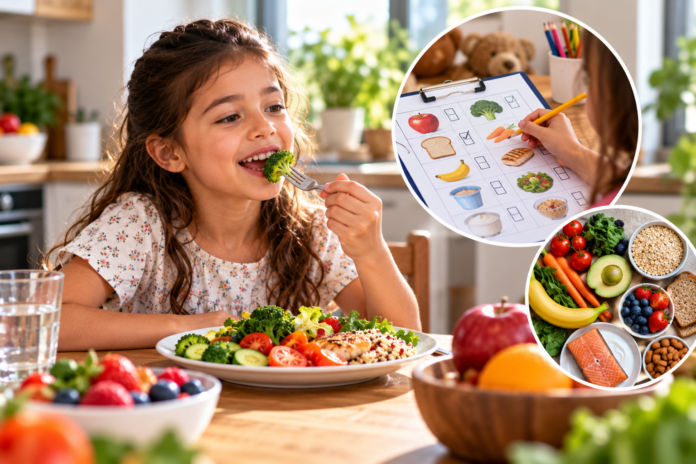
*New research reveals the reliability gap in measuring what kids actually eat—and why it matters for lifelong health*
KEY STATISTICS
- Food frequency questionnaires are a standard tool for measuring children’s dietary intake in research and clinical settings.
- Diet quality assessment in childhood years helps establish patterns that often continue into adulthood.
- Accurate dietary tracking relies on both the measurement tool itself and consistent responses over time.
If you’ve ever tried to remember exactly what you ate three days ago, you know how hard it is. Now imagine asking a 7-year-old to recall their eating habits over weeks or months. Researchers have long struggled with this challenge, which is why scientists recently tested whether a detailed food frequency questionnaire—a survey designed to measure what kids eat—actually produces reliable results when used multiple times with the same children.
Their findings offer parents and educators a clearer picture of how we track dietary health in the young years that shape a lifetime of eating habits.
What the study measured
When researchers want to understand what children eat, they use tools called food frequency questionnaires, which ask detailed questions about how often kids consume specific foods over a set time period. The 69-item questionnaire tested in this research measures both the variety of foods eaten and the overall quality of a child’s diet. Reliability—whether the tool gives consistent results when used repeatedly—is crucial for any measurement to be trusted in research or health guidance.
- Food frequency questionnaires capture dietary patterns by asking how often children eat specific foods over weeks or months.
- A reliable measurement tool produces similar results when given to the same person at different times, showing stable eating habits.
- Diet quality scores combine intake frequency with nutritional value to create an overall picture of eating health.
- Consistency in responses helps distinguish real dietary patterns from random variation or forgetfulness.
Why elementary years matter
Children aged 7 to 9 are in a critical window for dietary habit formation, yet they’re also among the hardest to assess accurately. At this age, kids are developing independent food preferences while still relying on parents for meal decisions—creating a unique measurement challenge. Understanding how reliable our dietary tracking tools are in this group directly affects how we guide children’s nutrition during these formative years.
- Children ages 7-9 are forming dietary preferences that often persist into adolescence and adulthood.
- This age group can recall some dietary information but may struggle with precise timing or portion details.
- Parent involvement in meal reporting can introduce inconsistency, as different adults may have different memory of what was eaten.
- Early dietary patterns established now influence metabolic health, energy levels, and long-term disease risk.
Signs your child’s diet tracking may be unreliable
- Reported intake varies dramatically between assessments without obvious changes in actual eating habits.
- Child or parent cannot consistently remember portion sizes or exact frequency of snacks and meals.
- Responses focus only on ‘healthy’ foods reported to the person asking, while omitting typical daily choices.
- Child’s reported intake doesn’t match energy level, growth rate, or what you observe them actually eating.
- Multiple family members give conflicting accounts of the same meals or snacks.
Better ways to track what kids eat
Rather than relying solely on memory-based questionnaires, a more practical approach combines multiple methods for understanding a child’s diet. Direct observation during meals, food photography, and regular conversations about eating habits all offer valuable insights that complement formal dietary assessments. The goal isn’t perfect precision but rather building an honest, usable picture of your child’s nutritional patterns.
- Keep a simple food photo journal for a week rather than relying on memory over months; it’s more accurate and reveals patterns quickly.
- Ask specific questions during meals (‘What did you eat at lunch today?’) rather than vague ones about weekly habits.
- Use a checklist approach: ‘Did you have fruit today? Vegetables? Protein?’ instead of asking children to estimate frequency.
- Involve your pediatrician or dietitian in formal assessments when dietary concerns arise rather than trusting recall alone.
Action plan: Start here today
- This week, observe and note what your child actually eats at each meal without judgment—use this as your baseline.
- Take photos of meals and snacks for three days to create an accurate visual record of typical intake.
- Ask your child’s school for lunch menus and ask them directly what they ate, then compare with the printed menu.
- Schedule a conversation with your pediatrician about your child’s diet quality, bringing your observations as concrete evidence.
- Create a simple weekly checklist of food groups and whether they appeared in your child’s meals, rather than trying to count servings.
The role of parental awareness
Parents are often the real measurement tool when tracking children’s diets, yet we’re not always trained in how to do this accurately. Busy schedules, packed lunches eaten away from home, and genuine memory limitations all introduce gaps. Building your own awareness of what your child typically eats—without obsessing over perfect tracking—is actually more valuable than any questionnaire.
- Parents who eat meals with their children can report dietary intake far more accurately than those who rely on secondhand accounts.
- Awareness of your own food biases matters: we tend to remember and report ‘healthy’ choices more than actual intake.
- Regular informal check-ins (‘How was your breakfast?’ during pickup) build understanding without the pressure of formal assessment.
- Consistency matters more than perfection; tracking your child’s typical week is more useful than isolated ‘perfect days.’
Bottom Line
While questionnaires and formal assessments have their place in research and clinical care, they work best when paired with direct observation and honest parent-child conversations about food. The most reliable picture of your child’s diet emerges not from a single tool but from paying attention to their actual eating habits over time. Use these insights to support their growing independence while gently guiding them toward patterns that will serve their health well into adulthood.
365 Live Long — always consult a qualified healthcare provider before making changes to your health routine.
Sources
- Reproducibility of a 69-Item School Children’s Food Frequency Questionnaire (69-Item SCh-FFQ) and Diet Quality Scores Among Polish Children Aged 7-9 Years — Nutrients
- General guidance on child nutrition and dietary assessment — CDC
- Childhood nutrition and lifelong health outcomes — WHO

